 |
MORE INFO Learn more about the life of Marc Connelly. Read “McKeesport was hometown to area’s first Pulitzer dramatist,” Focus Magazine, Tribune-Review, May 5, 2002 (offsite) |
|
“One day, when the nineteenth century was drawing to a close, my father pinned a celluloid button on my jacket. He told me that the words on it were, 'Boost McKeesport — The Tube City!' But because I was a small boy, I was ignorant of those merits of our town which my father, a founder of its booster club, was prepared to communicate to any listener.
“I could not boast that McKeesport, Pennsylvania, the Home of the National Tube Works, outstripped the rest of the world in the production of iron pipe, was the fastest growing city in the Monongahela Valley, and might one day be as big as Pittsburgh, fifteen miles away. I willingly wore the button, but except for inviting all I met to look at it, I took no part in stimulating McKeesport's growth.
“Privately, I had not the faintest concern about the city's magnificent future. I was highly satisfied with its glorious present. By my standards, McKeesport was a metropolis unlimited in area and population. Pittsburgh was only a nebulous place that people went to on the trains that arrived and departed ... several times a day.”
—Excerpt from Voices Offstage (1968) by Marc Connelly,
1930 Pulitzer Prize winner for drama.
George Washington slept here—no, really
By Jason Togyer
George Washington slept here. So did a Pulitzer Prize winning playwright (Marc Connelly), two Olympic gold medalists (Rich Krivda and Swin Cash), a Miss America (Henrietta Leaver), an R&B pioneer (Art Rupe) and the first female airline pilot (Helen Richey).
Many great Americans were born and raised right here in McKeesport ... though Washington wasn’t one of them. He did, however, visit twice. On his first trip to McKeesport in 1753, Washington met with Queen Allequippa, leader of the local Native Americans. Two years later, Washington and other British and colonial soldiers camped along what’s now known as Lincoln Way as they prepared to battle the French for control of the Ohio Valley. (The battle didn’t go well, to say the least.)
‘McKee’s Port’
McKeesport’s history isn’t filled with military battles. In fact, things were downright sleepy until David McKee and his son, John, built a log cabin and established a ferry-boat service along the Monongahela and Youghiogheny rivers in 1769. In 1795, the McKee family founded a village they named for their ferry operation (“McKee’s Port”).
The village soon had a doctor, a blacksmith, a sawmill and a saloon. (Imagine a “Wild West” town, but with rivers and trees instead of cactuses!)
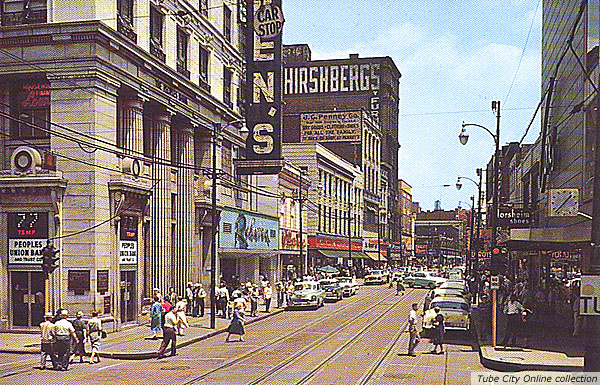
The town really grew after coal mines were opened here in 1830. Iron furnaces needed coal and water, and since McKeesport had plenty of both, the city's first foundry opened in 1851. From iron, workers also made steel. In 1857, the railroad arrived, enabling McKeesport factories to ship products around the world.
‘The Tube City’
Pretty soon, McKeesporters were turning steel into all sorts of useful things—especially pipes. In 1872, the National Tube Works Company was founded to make steel and iron pipes (or “tubes”) for water, oil and gas. In 1901, “National Tube” became part of the new U.S. Steel Corporation and McKeesport was making more steel pipe than any other city in the world. (That’s why they still call this “The Tube City.”) Soon more industries came to town. The city’s population boomed to 55,000 during World War II, when McKeesport’s factories employed more than 10,000 people making bombs, airplane parts and other vital defense supplies.
In the 1970s and ‘80s, the decline of the U.S. steel industry hurt McKeesport and other cities in Western Pennsylvania. Today, McKeesport’s population is one-third of its peak, and because of that, empty buildings and high unemployment are familiar problems.
Down, Not Out
Although McKeesporters have been beaten up, they haven’t given up. The legacy of the city’s great past includes historic landmarks and institutions such as the Carnegie Library and Renziehausen Park and its rose garden, the second-largest in Pennsylvania. McKeesport has its own community theater, symphony orchestra and art group, along with vibrant sports leagues with teams for adults and kids.
New institutions also make McKeesport proud. Propel McKeesport charter school was recently named the best in the United States. The McKees Point Marina has revived the “port” that the McKees founded more than 200 years ago. And visitors from around the world now pass through McKeesport on the Great Allegheny Passage bike trail between Pittsburgh and the East Coast.
The McKeesport area and McKeesporters have done a lot to build America, and they still have a lot more to offer. Forget the stereotypes and instead discover the McKeesport area for yourself. Use the pull-down menu to explore some of the articles we've got on the McKeesport area and its history.
© 2010 Tube City Community Media Inc., all rights reserved